Welcome to the Mathematical World!
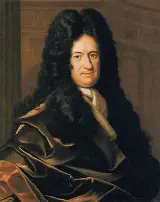
Gottfried Wilhelm Leibniz (1646 – 1716)
Co-Inventor of Calculus and Pioneer of Symbolic Logic
Leibniz co-invented calculus independently of Newton, but his elegant notation—the integral sign \(\int\) (from the Latin summa) and the differential \(d\)—became the global standard. His formulation shaped the way generations of mathematicians think about change, motion, and infinitesimal processes. For example: \[ \int_a^b f(x)\,dx \quad \text{represents the area under a curve,} \] while \[ \frac{dy}{dx} \quad \text{denotes the instantaneous rate of change.} \]
He viewed mathematics not merely as numbers and operations but as a universal language of reasoning capable of representing all rational thought. This vision led him to develop early ideas in symbolic logic and combinatorial analysis, anticipating formal systems that would later inspire Boolean algebra and modern computing theory.
Leibniz also designed and constructed mechanical calculators capable of performing addition, subtraction, multiplication, and division. These machines were among the earliest steps toward automated computation. His dream of a “universal calculus” for reasoning foreshadowed the development of algorithms, computer science, and even artificial intelligence.
He applied mathematics widely, to physics, engineering, law, and even theology, believing that the precision of mathematics could illuminate truth in all fields. His optimism is famously captured in the phrase, “We live in the best of all possible worlds.”
Leibniz’s legacy influenced not only mathematicians like Leonhard Euler and Joseph-Louis Lagrange but also philosophers and scientists for centuries. By treating mathematics as a formal, symbolic language, he laid foundations for logic, algebra, and computation that continue to resonate in modern science and technology.
Facts:
- Born in Leipzig, Germany.
- Introduced the integral sign \(\int\) and the differential \(d\).
- Built advanced mechanical calculators capable of complex operations.
- Envisioned universal reasoning systems that anticipated algorithms and AI.
- Maintained a lifelong intellectual rivalry with Isaac Newton.
- His writings influenced both mathematics and philosophy, bridging the two disciplines.

All rights reserved by the Mathematical Unity
Contact: +8801400044645
Email: mathematicalhorse1453@gmail.com
Our Discord Server: Mathematical Unity [Ulus Riyadiyat]